Tyler, Longview and the rest of Smith and Gregg counties sit in climate zone 3. For that zone, ENERGY STAR recommends R-49 for an attic with no insulation, and adding R-38 when the attic already has 3 to 4 inches. For floors over a crawl space, the same chart lists R-19.
Those are the numbers to aim for. The rest of this guide explains what they look like in your attic, how to check what you have now, and why the humid Piney Woods climate changes how the work should be done.
A quick word on R-value
R-value is a measure of how well a material slows heat. The bigger the number, the better it resists heat moving through it. Each material reaches a given R-value at a different depth, so the right number of inches depends on what is going into your attic.
- Blown in fiberglass: roughly R-2.2 to R-2.7 per inch
- Blown in cellulose: roughly R-3.2 to R-3.8 per inch
- Fiberglass batts: roughly R-3 to R-4 per inch
- Open cell spray foam: roughly R-3.5 to R-3.8 per inch
- Closed cell spray foam: roughly R-6 to R-7 per inch
Every bag of blown insulation has a coverage chart printed on it. That chart lists the settled depth needed for each R-value, and a careful installer follows it and marks depth rulers across the attic so you can see the result.
What R-38 and R-49 look like in inches
With blown fiberglass, R-38 usually means somewhere around 14 to 16 inches, and R-49 takes more. Cellulose reaches the same R-value with less depth. If you climb up and find 4 or 5 inches of gray, matted insulation, which is common in older homes around Tyler and Longview, you are well short of either target.
How to check your own attic
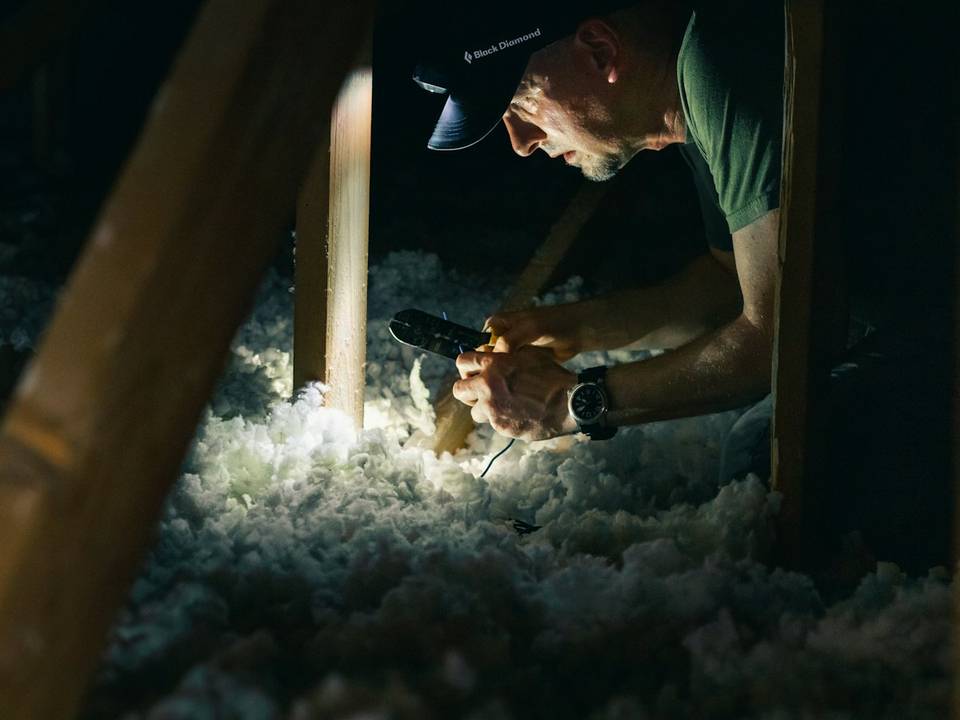
- Pick a cool time. East Texas attics get dangerously hot in summer. Go up early on a mild morning, bring a light, and wear a dust mask and gloves.
- Stay on the framing. Step only on joists or a walkway. The drywall below will not hold your weight.
- Look across the floor. If the tops of the ceiling joists are showing, you do not have enough.
- Measure in several spots. Push a ruler down to the ceiling and write down the depth near the hatch, in the middle and near the eaves.
- Check for moisture. Look for dark spots on the roof decking, stained or clumped insulation, and a musty smell. In this climate, those clues matter as much as depth.
Why East Texas attics need more than depth
East Texas summers are long, hot and sticky. The roof bakes in the sun, and the attic below it gets far hotter than the air outside. Thin insulation lets that heat soak through the ceiling, so the AC runs longer and the rooms under the attic never quite cool down.
Humidity adds a second problem. Many homes here have the air handler and ductwork in the attic. Those ducts carry cold air through hot, damp air, and when a duct is poorly insulated or leaking, water can condense on it and drip into the insulation below. Soggy insulation loses much of its value and can lead to stains and mold. Read more in our guide to attic moisture in a humid climate.
That is why the right answer is not always just more fluff. Some homes do best with a blown in top up. Others benefit from a radiant barrier to cut heat from the roof, or spray foam on the roof deck to bring the ducts inside the conditioned space. Spray foam on the roof deck needs to be designed with the HVAC system and humidity control in mind, which is something to talk through before you commit.
Seal the leaks before you add insulation
The U.S. Department of Energy advises sealing air leaks and making roof repairs before insulating. Insulation slows heat but does very little to stop moving air. Gaps around recessed lights, plumbing vents, wiring holes, the attic hatch and the tops of interior walls let humid attic air and dust move into the house, and let conditioned air escape.
Sealing the largest of those openings first makes the new insulation work the way it should. It also helps keep pine pollen and attic dust out of your living space, which many East Texas homeowners notice right away.
When old insulation should come out first
Blowing new insulation over a problem buries it. If you find any of these, plan on removal before anything new goes in:
- Insulation that has been wet from a roof leak or a sweating duct
- Mold on the insulation or the decking above it
- Rodent nests, droppings or heavy tunneling
- Smoke or odor from a past fire or long term contamination
Our insulation removal service clears the old material, lets us fix the cause, and gives you a clean start.
The short version
- Zone 3 target: R-49 for an empty attic, or add R-38 on top of 3 to 4 inches.
- Floors over a crawl space: R-19 per ENERGY STAR.
- Visible joist tops mean you need more.
- Seal air leaks first and fix moisture before you insulate.
- Ducts in the attic? Ask about a radiant barrier or roof deck foam.
Curious what all this would involve for your house? Our guide to what affects insulation cost walks through the factors, and we serve homes in Tyler, Longview, Whitehouse, Lindale, Kilgore and Bullard.
Want to know exactly where your attic stands? Request a free attic inspection and we will measure your insulation, check for moisture and give you a written recommendation.